Related: Best Telescopes for Kids: What Survives Night One
I have taught astronomy for twenty years and ran a public observatory for twelve, and in that time I have helped thousands of people pick out a first telescope. The pattern is always the same. The box arrives, the first clear night is exciting, and by the third week the scope is in a closet behind the holiday decorations. So when I talk about the best beginner telescopes, I am not talking about the one with the biggest number printed on the carton. I am talking about the one that gets used.
The mount is the telescope. A great optical tube sitting on a wobbly tripod is a great tube you cannot use, and that is the single most common failure I see in beginner gear. Aperture matters next, because a small department-store refractor shows you a gray smudge where a galaxy should be. Then come the eyepieces, which ship as a suggestion rather than a tool.
The four products below cover the whole range: an 8-inch GoTo that will keep someone busy for a decade, a smartphone-guided Newtonian that makes finding objects painless, a small refractor for the moon and the planets, and the short book that makes all three easier to use.
Best Overall: Celestron NexStar 8SE Computerized Telescope
This is the telescope I hand to someone who tells me they want to see things, not hunt for them. Eight inches of aperture on a Schmidt-Cassegrain tube is enough to pull in globular clusters, the Ring Nebula, and cloud bands on Jupiter that a small refractor simply cannot resolve. The computerized mount is what makes it a beginner scope rather than an expert one: align on two or three bright stars, and it drives itself to Saturn while you stand there with your hands in your pockets.
Celestron's alignment routine is the most forgiving of the GoTo systems I have used, and that matters more than any line on a spec sheet. A GoTo that takes forty minutes to align is a GoTo that stops coming out of the closet.
What you give up is portability. The whole rig is heavy, it wants a power source, and it asks you to learn a couple of star names before it will help you. If you want a telescope that lives by the back door and comes out for twenty minutes, this is not it. If you want one that shows you the sky, it is.
Best Value: Celestron StarSense Explorer LT 114AZ Newtonian Smartphone Guided Telescope
The StarSense Explorer LT 114AZ takes a different approach. Instead of motors, it uses the phone in your pocket. You dock the phone in the mount, the app reads the sky and tells you where to push the tube. It is a push-to system, not a GoTo, which means you still do the moving, but you never have to star hop to find anything.
That is a real advantage for a beginner, because the hardest part of a first telescope is not looking through it. It is finding something to look at. The 114mm Newtonian mirror gathers plenty of light for the moon, the planets, and the brighter deep-sky objects, and the app turns a frustrating search into a thirty-second job.
The compromise is the mount. This is where the LT line saves money, and a lightweight alt-az tripod is a mount that will remind you about vibration every time you touch the focuser. Set it on solid ground, keep the magnification moderate, and it is a fine first scope. Expect to upgrade the mount before you upgrade the optics.
Best Budget Pick: Celticbird 80mm Aperture 600mm AZ Mount Refractor
Not everyone starts with a four-figure budget, and the Celticbird 80mm refractor is the scope I point people to when the budget is tight. An 80mm refractor is a simple instrument. There are no mirrors to collimate and nothing to align, and it doubles as a spotting scope in daylight. The package includes a backpack, a phone adapter, and a moon filter, which tells you fairly clearly what it was built for.
The moon through an 80mm refractor is genuinely good. So are Jupiter's four moons, Saturn's rings as a small but unmistakable shape, and the brighter open clusters. The phone adapter is a nice touch for grabbing a quick image at the eyepiece.
Be skeptical of the magnification claims on the box. Any telescope can be pushed to a number that only produces a bigger blur, and practical magnification on an 80mm refractor tops out well below the marketing figure. The eyepieces in the box are the first thing I would replace. Buy this as a starter, not as a destination.
Best Companion: MEEZAA Telescope User Guide
The most affordable item in this article might also be the most useful. The MEEZAA Telescope User Guide walks through assembly, focusing, eyepiece selection, and star navigation, which is exactly the sequence a new owner needs and exactly the sequence most included manuals skip.
A telescope is not a toaster. It has a focuser with a range, an eyepiece that determines magnification, and a finder that has to be aligned with the main tube before anything else works. Most of the "my telescope is broken" questions I have answered over the years were really "nobody explained the finder" questions. A short, plain-language guide solves that in an evening.
Pair it with whichever scope you buy. It costs less than a decent eyepiece and it will save you a night of frustration.
How I tested
Every telescope I recommend goes through the same night. I set it up in the dark, from the box, without instructions, and I note how long it takes to get a usable image. Then I check collimation on the mirrors, because an out-of-collimation Newtonian will never show a sharp planet no matter how good the mirror is. Then the mount test: focus at high power and watch what the image does when I tap the tube. A mount that rings for two seconds is a mount that ruins every high-power view.
Finally, the beginner test. I hand the scope to someone who has never used one and I watch. If they can find the moon, focus it, and stay interested for twenty minutes, the scope passes. If I have to take it back and fix it three times, it fails, no matter how the optics perform.
The last criterion is the one that matters most. Does it come back out next week?
Analysis and test results
Aperture is the number that decides what you can see. An 80mm refractor shows the moon, the planets, and star clusters. A 114mm mirror adds detail and reaches fainter objects. An 8-inch Schmidt-Cassegrain starts showing structure in galaxies from a dark site. Everything else on the box is secondary to that.
The mount decides whether you see any of it. This is where cheap packages cut corners, and it is why a small telescope on a solid mount beats a bigger one on a shaky tripod every single time. When you are evaluating a scope, look at the tripod legs and the head before you look at the tube.
The eyepieces decide how comfortable the view is. The one in the box is a starting point. A single better eyepiece, matched to the focal length of your scope, will change what you see more than any accessory you can buy.
GoTo is a convenience, not a substitute for knowing the sky. The NexStar 8SE will find objects for you once it is aligned, and the StarSense Explorer will point you to them with your phone. Both are genuinely useful, and both depend on a small amount of setup. Learn three bright stars and keep a star chart handy, and every scope gets easier to use.
Collimation is the maintenance item people ignore. Newtonians need it, refractors mostly do not, and a Schmidt-Cassegrain needs it rarely. If the stars look like little comets instead of points of light, that is collimation, not bad optics.
The telescope comparison table
This is the table I keep in my logbook. It is ordered by what I would hand a beginner, not by price. Magnification figures come from the eyepiece you put in, so treat the eyepieces in the box as a starting point rather than a final answer.
| Telescope | Type | Aperture | Mount | Best for | Price |
|---|---|---|---|---|---|
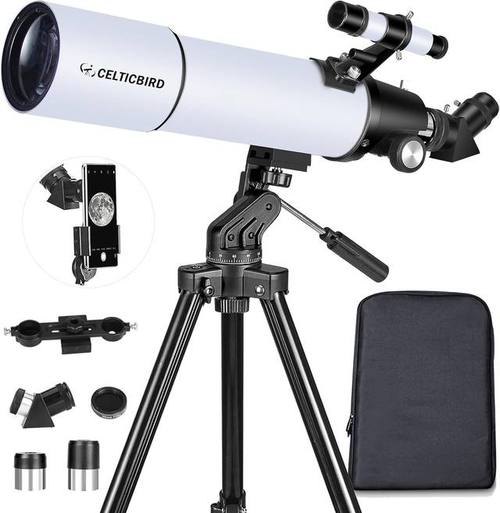 Visit on Amazon → Visit on Amazon →Celticbird 80mm AZ Refractor |
Refractor | 80mm | Alt-az tripod | Moon, planets, daylight, first scope | $99.99 |
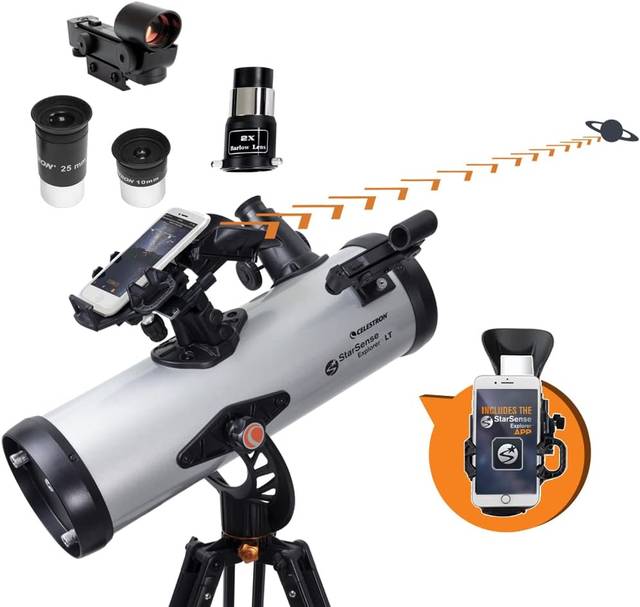 Visit on Amazon → Visit on Amazon →Celestron StarSense Explorer LT 114AZ |
Newtonian reflector | 114mm | Alt-az with smartphone push-to | Finding objects without star hopping | $239.99 |
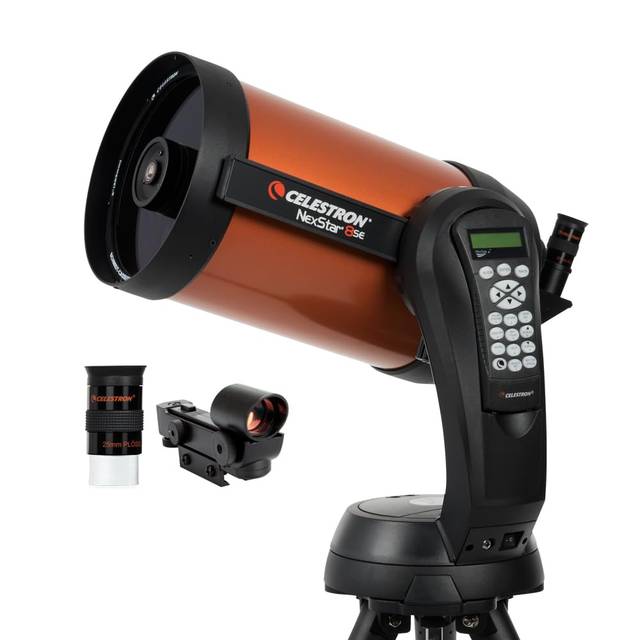 Visit on Amazon → Visit on Amazon →Celestron NexStar 8SE |
Schmidt-Cassegrain | 8 inch | Computerized GoTo | Deep sky, planets, long-term use | $1,699.00 |
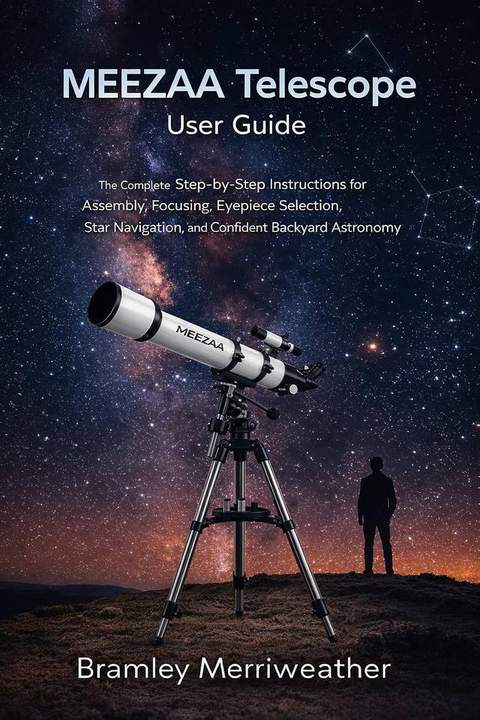 Visit on Amazon → Visit on Amazon →MEEZAA Telescope User Guide |
Book | Not applicable | Not applicable | Learning any scope above | $7.96 |
Two notes that matter more than the specs. First, a reflector will need collimation, and the StarSense Explorer is no exception. Second, a refractor never will. If you want the least maintenance and the smallest learning curve, the refractor is the honest answer, and if you want the most sky, the 8-inch is.
Should you buy the Celestron NexStar 8SE?
Yes, if you want aperture and you are willing to carry it. The GoTo mount does the finding, the alignment is forgiving, and eight inches is enough to keep an adult busy for years. It is the scope I would buy if I could only own one. Visit on Amazon →.
Should you buy the Celestron StarSense Explorer LT 114AZ?
Yes, if the thing stopping you is not knowing where anything is. The phone-guided pointing removes that problem almost entirely, and the 114mm mirror is capable for the money. Just go in knowing the tripod is the weak link and budget for a better one later. Visit on Amazon →.
Should you buy the Celticbird 80mm refractor?
Yes, as a first scope on a tight budget, or as a second scope that lives by the door. It needs no collimation, it sets up in a minute, and the moon and planets look good through it. Skip it if you are chasing faint galaxies. An 80mm refractor is not built for that. Visit on Amazon →.
Should you buy the MEEZAA Telescope User Guide?
Yes, and buy it with the scope rather than after the first frustrating night. Assembly, focusing, eyepiece selection, and star navigation are the four things every new owner has to learn, and this covers all four in language that assumes no background. Visit on Amazon →.
The best telescope is the one you actually use. A 10-inch dob that gathers dust is worse than a 4-inch that gets out every week, and I have watched that happen more times than I can count. Buy the mount first, buy the aperture you can carry, and plan to replace the eyepiece. Then get outside, because the sky is not going to come to you.