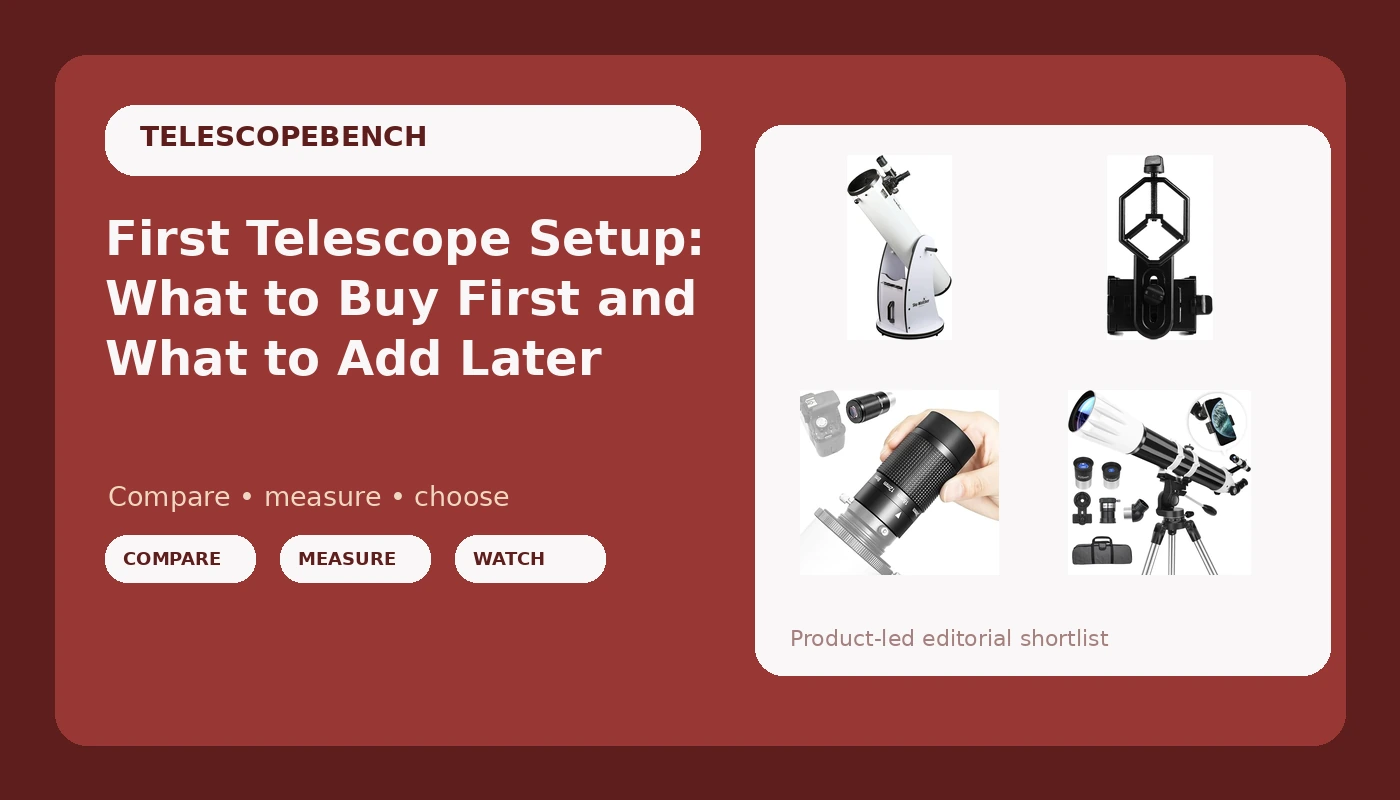
A first telescope setup is rarely one purchase. It is a chain of decisions: how much aperture you can carry, how steady the mount is, and whether the eyepiece in the box is something you will still want to use in week two. Get the mount wrong and the finest optics in the world will still shake every time you touch the focuser. Get the eyepiece wrong and a capable scope will feel like it has nothing to show. And get the aperture wrong in the wrong direction, meaning too small, and the Moon looks fine while everything else looks like a smudge.
This is an explainer, not a ranking. The four items below cover both ends of a beginner setup and two accessories that solve specific problems. One is a large-aperture Dobsonian that trades portability for light gathering. One is a compact refractor that arrives with a mount, a bag, and a phone adapter. The other two are the upgrades most beginners end up buying anyway. Everything described here comes from the specifications the manufacturers publish, not from a test session I have not run.
Related: How to Collimate a Newtonian Reflector Without Losing Your Mind →
Quick answer
Start with the largest aperture you will genuinely carry outside, put it on the steadiest mount you can afford, and plan on at least one eyepiece you chose rather than the one that came in the box. For most beginners that means an 8-inch Dobsonian if you observe from home, or a 90mm refractor if the scope has to travel and set up in minutes. A zoom eyepiece replaces a handful of fixed focal lengths with one barrel, and a phone adapter is a small addition that lets you show other people what you are seeing. None of these decisions require electronics, and none of them require a magnification number in the hundreds.
Four useful options
| Model | Best fit | What stands out |
|---|---|---|
| Sky-Watcher Classic 200 Dobsonian 8-inch Telescope | Observers with a place to store and carry a large tube | 8-inch aperture on a solid-tube Dobsonian base with no electronics to align |
| Hawkko 90mm Aperture 900mm Telescope | Small homes, travel, and short sessions | 90mm refractor with 900mm focal length, AZ mount, phone adapter, and carry bag included |
| Astromania Zoom Eyepiece 8-24mm | Replacing one fixed eyepiece with a usable range | 1.25-inch barrel with a continuous 8mm to 24mm zoom |
| SVBONY Universal Cell Phone Adapter | Sharing the view or taking quick snapshots | Clamp fits eyepiece barrel diameters from 25mm to 48mm |
The main scope: Sky-Watcher Classic 200 Dobsonian 8-inch Telescope
The argument for this scope is not about features, it is about where the money goes. A Dobsonian base is a wooden rocker box that sits flat on the ground, which removes the tripod entirely, and a tripod is where most beginner setups fail. There is no leg to kick, no head to flex, and no center of mass perched above three thin aluminum tubes. You push the tube where you want it and it stays.
The trade-offs are real and worth naming before you buy. A solid-tube 8-inch is bulky, and the base and tube travel as two pieces, so it is a two-trip-to-the-yard scope rather than a one-hand grab-and-go. It does not track, which means anything at high magnification drifts out of the field and you nudge it back. And a Newtonian reflector needs its mirrors aligned, so collimation is a skill you will learn in the first month whether you want to or not.
What you get in return is aperture. In visual observing, aperture sets both how much light you collect and how finely the optics can resolve detail, and it is the single specification that most reliably separates a scope that shows galaxies and globular clusters from one that mostly shows the Moon and a few planets.
The compact alternative: Hawkko 90mm Aperture 900mm Telescope
A refractor has one structural advantage that matters to a beginner: the optics are sealed in a tube and stay aligned. There is no mirror to collimate, no secondary to nudge in transit, and nothing to adjust before the first look. That makes a refractor the lower-friction choice for someone who wants the scope to work on night one, and it makes a 90mm kit a reasonable answer for a balcony, a small closet, or a car trunk.
The honest limitation is light gathering. Ninety millimeters of aperture collects far less light than an 8-inch mirror, so the Moon, the planets, double stars, and the brighter open clusters are the natural targets, while faint galaxies and nebulae will be dim or invisible depending on your sky. The advertised magnification range is a description of what the supplied eyepieces and the focal length can produce, not a promise about image quality at the top of that range. Aperture and atmospheric steadiness set the practical ceiling, and on most nights a 90mm scope runs out of usable magnification well before the printed maximum.
Where this kit earns its place is convenience. Mount, adapter, and bag arrive together, so the barrier between deciding to observe and actually observing is one trip outside.
The eyepiece upgrade: Astromania Zoom Eyepiece 8-24mm
The eyepiece that ships with a telescope is a starting point, not a toolkit. Most bundled eyepieces are chosen to hit a price, and the result is one narrow field of view that works for the Moon and little else. A zoom eyepiece addresses that directly: instead of swapping barrels in the dark, you turn a collar.
The arithmetic is straightforward and worth doing before you buy. Magnification is the telescope's focal length divided by the eyepiece's focal length, so on the 900mm refractor above this zoom produces about 37.5x at the 24mm setting and about 112.5x at 8mm. On a longer-focal-length instrument, the same eyepiece reaches higher magnifications. That single range covers wide-field scanning, lunar and planetary viewing, and the step up in power you need to split double stars, all without changing eyepieces.
The trade-off is optical: a zoom is a compromise design, and a dedicated fixed eyepiece of the same focal length often shows a slightly wider apparent field, especially at the long end of the range. What you buy with a zoom is convenience and fewer decisions in the dark, which for a beginner is usually the more valuable currency.
The sharing accessory: SVBONY Universal Cell Phone Adapter
This is the accessory that turns a solo hobby into something you can share. Holding a phone up to an eyepiece by hand works for about three seconds before the image slides away, and the adapter exists to remove that variable. It clamps around the eyepiece barrel and positions the phone camera over the eye lens.
Two practical points. First, check the barrel diameter of your eyepieces before buying: this clamp covers 25mm to 48mm, which includes standard 1.25-inch and 2-inch barrels, but a very small or unusually shaped eyepiece may not fit. Second, understand what it is for. This is afocal photography, meaning the phone camera shoots through the telescope's eyepiece. It works well for the Moon and bright planets, which are bright enough for a short phone exposure. It is not a substitute for a dedicated astronomy camera and an equatorial mount, and it will not produce long-exposure deep-sky images.
Prices and availability may change. Product images, names, and retailer links must be matched by verified ASIN. Do not state a current price, rating, stock status, or measured result without current evidence.
How aperture and focal length decide what you actually see
Two numbers control almost everything about a visual telescope. Aperture, the diameter of the main mirror or lens, determines how much light the instrument collects and how much fine detail it can resolve. Focal length, the distance over which the optics bring light to a focus, determines the magnification you get from a given eyepiece.
Magnification is simple division: telescope focal length divided by eyepiece focal length. A 900mm scope with a 24mm eyepiece gives 37.5x; the same scope with an 8mm eyepiece gives 112.5x. Notice that magnification is a consequence of two other choices, not a property of the telescope by itself, which is why a magnification figure printed on a box tells you almost nothing on its own.
There is a practical ceiling. A long-standing guideline is roughly 2x per millimeter of aperture, or about 50x per inch, under good conditions. For a 90mm refractor that lands near 180x, and for an 8-inch mirror near 400x. That ceiling is set by the optics and by the atmosphere above you, and on many nights the atmosphere is the tighter limit. This is why a scope advertised at 270x or higher is not lying, exactly, but is also not promising that the view at that power will be sharp.
Why the mount matters more than the magnification number
A telescope has two jobs: gather light and hold still. The optics do the first. The mount does the second, and a mount that fails makes the optics irrelevant. Every vibration shows up as a smear at high magnification, and the higher you push the power, the more a shaky tripod punishes you.
This is why the Dobsonian approach is so effective at the beginner end of the market. A rocker box sitting on the ground has no legs to flex and no head to sag. Alt-azimuth movement in two axes is intuitive: up and down, left and right. Manual pointing means no alignment routine that can fail at 9pm and end the session before it starts.
Tripod-mounted scopes and computerized GoTo mounts are not inherently worse, but they add variables. A tripod needs to be extended as little as possible and placed on solid ground. A GoTo mount needs a power source and an alignment procedure that has to be done correctly. For a first scope, fewer variables means more nights under the sky, and more nights under the sky is the only thing that makes anyone better at this.
- Decide where you will actually observe, whether that is a back yard, a balcony, or a site you drive to.
- Measure your storage space and carrying limit before choosing aperture, because the scope you cannot lift is the scope you will not use.
- Spend on the mount before you spend on accessories, since stability affects every single view.
- Plan to replace the bundled eyepiece with a zoom or a small set of fixed focal lengths.
- Add the phone adapter last, after you know the barrel diameter of the eyepieces you actually own.
Setting up without wasting the first night
- Assemble the scope indoors in daylight and practice pointing it at a distant landmark before dark.
- Collimate a Newtonian before the session, and check it again after any car trip.
- Set the scope outside early so the optics can reach the outside temperature and stop distorting the image.
- Start every session at the lowest magnification, focus, and then step up rather than starting high.
- Keep a red flashlight and a chair handy, because comfort is what keeps a session going past an hour.
Which option should you choose?
Choose the Sky-Watcher Classic 200 Dobsonian 8-inch Telescope when you have a place to store a large tube and observe mostly from home or from a short drive, and you want the most aperture for the money with nothing electronic to align. Choose the Hawkko 90mm Aperture 900mm Telescope when space, stairs, or travel rule out a big tube, and you want a mount, a bag, and a phone adapter in one box. Choose the Astromania Zoom Eyepiece 8-24mm when you are tired of swapping one fixed eyepiece in the dark and want a single barrel covering low to moderate power. Choose the SVBONY Universal Cell Phone Adapter when the goal is to show the Moon or a planet to someone else, or to grab a quick snapshot, and you have confirmed your eyepiece barrel falls between 25mm and 48mm.
None of these choices fixes a bad sky or a wobbly setup. Aperture helps with light gathering, but no telescope cuts through light pollution or atmospheric turbulence, and no accessory makes a shaky mount steady. If a scope arrives out of collimation or with a damaged optical tube, the remedy is a return or a warranty claim, not a new eyepiece. And nothing here should be bought on the strength of a magnification number alone.
The bottom line
A first telescope setup works when the pieces agree with each other. An 8-inch Dobsonian delivers the most light for the money if you can move it, and its ground-based rocker mount sidesteps the tripod problem entirely. A 90mm refractor kit gives up light gathering in exchange for a scope that travels, sets up fast, and needs no collimation. A zoom eyepiece makes the range of usable magnification available without fumbling in the dark, and a phone adapter turns a private view into something you can share.
Pick the aperture you will actually carry, put it on the steadiest mount you can, and treat the eyepiece as part of the purchase rather than an afterthought. Check current Amazon price on each piece before you commit, since availability and pricing move, and confirm the specifications that matter to you: aperture, focal length, mount type, and eyepiece barrel size.